● The wave pattern
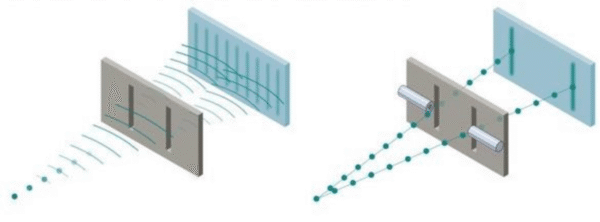
The particles are experiencing a „drag” or „friction” while going through the slit. Some particles go through, while others don’t make it to the detector screen. Why is there a pattern on the screen? The pattern is actually formed due to an accumulation of dots, each representing a particle. So, collectively, they appear like a wave imprint. My theory is that the thickness of the slits screen matters because it plays a role in defining the trajectory towards the detector screen. Some are „dragged” to the right or left, and some go up or down, and others simply go through the middle (not interacting that much with the edges of the slit). I am thinking of it like: „a moving particle through a slit, if closer to the edge tends to ‘flow’ alongside the wall (which here is the thickness of the slits screen, which for a particle means a considerable distance)”. This is why the pattern appears: particles squeeze through the slit and interact with the edges (maybe not the particles themselves, but for sure their fields). Electrons, for example, come with an electromagnetic field (electricity in general has a magnetic and a thermal effect). There might be a tendency to curve around the edges of the slit, but due to the high speeds (of the particles), they overcome this tendency and land on the detector screen, forming a wave-like pattern. I am thinking of it like a quantum-level Coanda effect. The Zitterbewegung also plays a role, because it determines how the particle behaves at and after interacting with the slit screen.
1. If the particle has a left-right wobble, when it hits the edge of the slit while the wobble state is on the right side, it has the tendency to move to the right. Through the other slit another particles moves to the left (if the wobble is caught on the left side).
2. If the particle hits the edge of the left slit while its vibrational state is caught on the left, it moves more to the left. And in the case of the other slit, a particles would move to the right.
So far, there is nothing special about it.
3. Now, if the vibrational state is up-down, the particle tends to move in a more straight line, only slightly to the left or right (it interacts less with the edges).
4. If the particle hits the left side of the slit, regardless of its Zitterbewegung state, it will have the tendency to „flow” to the left. The same goes for each slit and all the situations from above. It is a matter of „proximity” in relation with the edges of the slits. Closer to the edge means: „sticking” more to the slit’s edge, and having a side-way trajectory.
This applies for both slits and each slit is doing the opposite of the other (in one slit a particle moves more to the left and through the other slit another particle moves more to the right (due to Zitterbewegung) – this is the reason of the symmetry we see on the screen).
So, we have more particles in the middle, more particles near the middle and fewer on the sides. Points one 1. 2. and 4. ensure the less bright fringes further from the middle, while points 1. 2. 3. and 4. ensure the bright fringe in the middle and immediately next to it (left and right sides), because the up-down wobble tends to not interact that much with the sides. The right-left wobble adds up to the up-down situations, leading to more particles in the middle and in the left and right side of the middle fringe.
● The two-fringe pattern
When we want to observe the particle, we usually send photons to make sense of what is happening, but when the photon collides with the particle, the particle gains energy and a higher speed, so it goes through the slit faster and doesn’t interact that much with the edges of the slit; it manages to overcome the curving tendency.
● Why are there dark regions in a single slit experiment, and why do they become filled with dots in the case of two slits?
Because the field surrounding the particle is interacting in the first case with the edges of one slit, while in the double slit case, it interacts with both slits. So it is like a new setup, and the outcomes are different.
● Time doesn’t matter, because the experiment is based on probabilities, so it is only a mathematical calculus which states that the wave pattern or the two-fringe pattern follows the equation every time.
● Why does the particle go through a slit and not always hit the middle, slits divider?
Because of Zitterbewegung, which says that particles are not static, but are always vibrating. So the vibration of the particle induces an uncertain outcome of the trajectory of the particle: some collide with the middle part while others go through the slits, based on their vibrational state when arriving at the slit screen. Since the Zitterbewegung follows a finite vibrational state (up-down, left-right) I think we can say that the wave pattern on the screen is always there, because a particle also has a finite modes of interacting with the slit/slits, ensuring the nonchaotic waves pattern we observe (due to repetition).
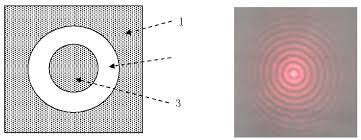
● Two circular slits
In this case on the detector screen you will see two bright spots in the middle, each surrounded by overlapping circles eventually becoming fainter (the circle „fringes”) as they are further apart from the centers. This proves that the particles tend to „flow” along the edges of the slits.
Prediction:
If you were to shine a light beam on a cylinder shaped mirror and place a detector screen at where the light is reflected (where the photons gather), you would notice fringes appearing in a wave like manner. This proofs that particles are particles and they behave as such. A particle can’t be a wave and a particle, a particle is and behaves as a particle, very close to how in a mechanical sense you would shoot small marbles into a cylinder shaped pillar. More particles landing on the detector screen will resemble collectively a wave-like pattern. They physically interact with the cylinder and due to Zitterbewegung (which implies a finite way of vibrations regarding the particle), the wave pattern appears in a given amount of time, composed of many particles landing on the detector.
Double slit experiment with atoms and molecules:
They did the double slit experiment with atoms and even molecules and the results were the same as in the case of particles. This proves my theory that there is a friction of some sort with the edges of the slits.